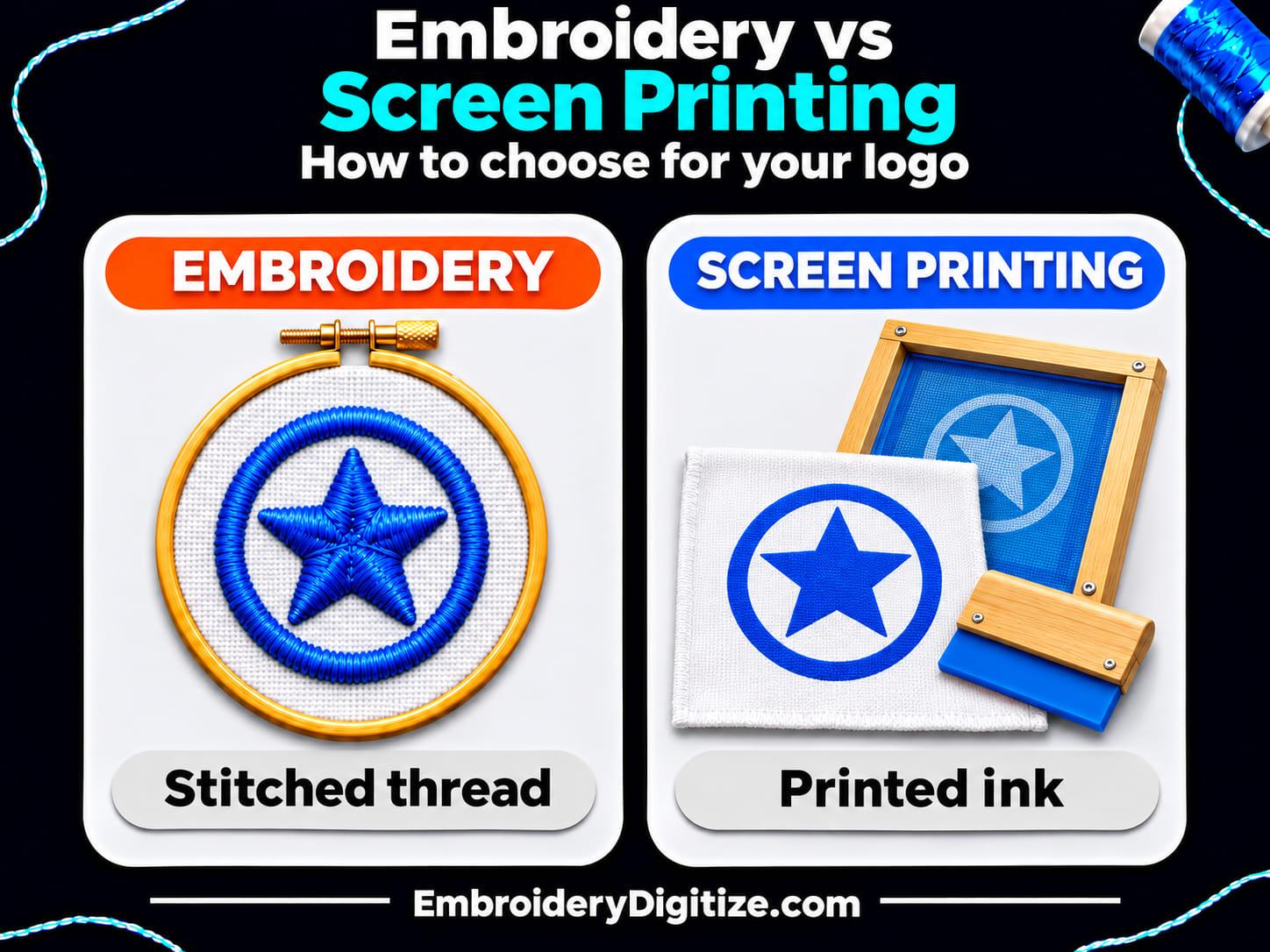
Quick answer: Embroidery stitches thread into the garment, while screen printing presses ink through a mesh stencil. Printful and Printify say embroidery suits small, simple logos on sturdier garments and lasts longer, while screen printing suits larger, bolder or more detailed artwork in bigger runs. Your logo, garment and quantity decide, so ask for a sample.
Choosing between embroidery and screen printing usually comes down to what your logo looks like, what it goes on and how many pieces you need. This guide collects what sellers and manufacturers publish about both methods: how they work, how much detail each can hold, how long they are said to last, how they are priced and which garments suit them. It also covers heat transfer vinyl, direct-to-garment (DTG) printing, direct-to-film (DTF) printing and sublimation briefly, because people often compare embroidery with those too. It is about logos on garments, not patches or hand embroidery.
The facts come from guides by print-on-demand and merchandise platforms (Printful, Printify and Fourthwall), custom apparel and uniform sellers (Rush Order Tees, TeeOne, Alsco, Quality Logo Products and Thread Logic), Vistaprint and Shopify, all opened on November 25, 2026. Nearly all are written by companies that sell decorated apparel or print-on-demand products, so their statements are claims, not test results, and the pages disagree in places. We did not stitch or print a sample, wash a garment or measure anything. EmbroideryDigitize sells embroidery digitizing, so we have an interest in embroidery; where the sources say printing fits better, we say so.
What Is the Difference Between Embroidery and Screen Printing?
Printful and Printify describe embroidery as stitching thread into the fabric by machine. The logo is first digitized, which means it is converted into a stitch file that tells the machine where to place each stitch and where to change thread colors. Printful's DTG guide says you must first "convert a digital design into a stitch file through digitization". Printful and Fourthwall describe the result as raised, textured stitching. Printful, Printify and Vistaprint describe screen printing as pushing ink through a stenciled mesh screen onto the surface. Printful, Printify and Shopify describe one screen per color: the artwork is separated by color, each color gets its own screen, and the garment goes through each screen in turn before the ink is cured with heat.
The table shows what the sources say, not what we measured. Names in brackets show where each statement comes from. Printful attributions refer to its embroidery vs screen printing comparison unless the text names another Printful guide, and Vistaprint attributions refer to its screen printing guide unless the text names its sublimation guide.
| What to compare | Embroidery | Screen printing |
|---|---|---|
| How it is made | Thread is stitched into the fabric by machine from a digitized stitch file (Printful, Printify). | Ink is pressed through a mesh screen, one screen for each color, then cured with heat (Printful, Printify, Fourthwall). |
| Look and feel | A raised, textured finish (Printful, Fourthwall, Rush Order Tees). | Usually a smooth, flat finish (Printful, Printify). Fourthwall and Rush Order Tees also mention special inks such as puff. |
| Fine detail | Limited by the width of thread; small text and thin lines are the usual problem (Printful, Printify). | Printful and Printify say it reproduces fine detail better than thread. Fourthwall says fine details and color gradients can be harder to reproduce. |
| Colors | Thread color limits vary by provider (Printful, Printify, Quality Logo Products). | Conventional printing needs a screen for each color, so more colors cost more (Printful, Printify, Quality Logo Products). Vistaprint also lists four-color and simulated process printing for complex designs. |
| What drives the price | Stitch count and machine time (Printful, Printify, Rush Order Tees). | Number of colors and the setup, spread over the run (Printful, Printify, Rush Order Tees). |
| Durability, as the sellers describe it | Called the longer lasting of the two by Printful, Printify, Rush Order Tees, Alsco and TeeOne. The usual risk named is snagged or frayed thread (Printful, Quality Logo Products). | Called durable but less so than embroidery by the same sources. Ink can crack or fade with heavy washing (Printful, Printify, TeeOne). |
| Typical garments | Thicker or structured items such as polos, jackets, caps and bags (Printful, Printify, Rush Order Tees). | Flat, smooth items such as cotton T-shirts and tote bags (Printful, Printify). |
| Artwork preparation | The logo must be digitized, and complex elements may need to be simplified first (Printify, Rush Order Tees). | The artwork is separated by color and simplified for printing (Printful, Rush Order Tees). |
Printful sums up the detail trade-off like this: "embroidery is limited by physics, screen printing by cost." The sections below show that other sources also name physical limits for printing.
Which Method Handles Fine Detail and Small Text Better?
Printful says thread has physical width, so small text closes up and thin lines disappear. Two sellers publish numbers. Printful's comparison table says detail is "Limited below roughly 0.25 inches (0.63cm) of letter height", and Printify says embroidery needs design elements "at least 0.05 inches thick" and text "at least 0.25 inches tall" to stitch cleanly. Neither page says whether its figure refers to capital or lowercase letters. For a quick conversion (our math), 0.25 inch is about 6.4 mm and 0.05 inch is about 1.3 mm. These are figures that two sellers give for their own services. Other sources publish smaller and larger limits for particular fonts and threads, so see our small text embroidery guide for the full range.
Printing has its own limits. Printful says screen printing reproduces intricate artwork and small text more faithfully than thread, and Printify says it handles gradients, photographic images and fine details that embroidery cannot reproduce cleanly. Printful also lists "Struggles with gradients, which require halftone simulation" as a screen printing drawback, and Vistaprint's guide describes halftone screen printing as using "dots of varying sizes and spacing to create gradients and shading", and also lists four-color (CMYK) and simulated process screen printing for complex, multi-colored designs. Fourthwall lists fine details and color gradients as harder to reproduce in screen printing, says it is "Not ideal for photo-quality artwork or designs with lots of colors", and lists DTG and DTF as its full-color, detailed options.
The sources do not fully agree. TeeOne says embroidery "excels at capturing intricate details in logos or designs with multiple colors" and that very fine details "might not translate well" in screen printing. Quality Logo Products says the opposite about embroidery: it "can't capture all of the details and isn't able to produce gradients". Treat any statement about detail as general and test your own logo.
Colors work differently too. Printful and Printify say each screen printing color needs its own screen, so cost climbs with the number of colors. Printify still says screen printing handles complex, multicolor artwork more easily than embroidery, while Printful and Fourthwall favor designs with few colors. Embroidery uses thread colors, and the limits depend on the provider. Printful says "Most providers limit thread colors, often to around 15 per design", while Printful's DTG guide says its own service offers "unlimited color embroidery" and can produce gradient stitches. Printify's embroidery service allows up to six colors from a palette of 15, and Quality Logo Products says "7 or 8 thread colors" are included in its price. Rush Order Tees adds that "achieving smooth gradients or color blends is challenging" in thread. If your logo has a photograph or a gradient, see our guide to digitizing photos for embroidery.
Which Lasts Longer, Embroidery or Screen Printing?
Printful, Printify, Rush Order Tees, Alsco and TeeOne say embroidery lasts longer, and Printify's wording is that embroidery "generally outlasts screen printing after frequent washing". Fourthwall and Quality Logo Products rate both methods as long-lasting. Fourthwall's comparison table lists screen printing at "100+ washes", while Printify says screen-printed ink "can fade or crack within 40 to 100 washes, depending on quality and curing". Neither page says how its figure was measured, and none of the pages we read describes a wash test. Treat the numbers as seller estimates with no published test method.
The sources name different weak points. Printful says embroidery's main failure point is that "Threads can snag or fray", and that heavily washed prints can crack at fold lines and high washing temperatures fade them. Printify says screen-printed ink can crack or peel if the cure falls short. Quality Logo Products suggests washing screen-printed garments inside out and air drying them, and washing embroidered garments in a mesh laundry bag. Several of the pages are older (Quality Logo Products 2017, Thread Logic 2021, Alsco 2023), so check current provider details before you order.
Is Embroidery or Screen Printing Cheaper?
Printful, Printify and Rush Order Tees say screen printing gets cheaper per piece as the run grows, while embroidery follows stitch count and changes less with quantity. For small orders the sources disagree. The two methods charge for different things:
- Embroidery is priced by stitch count and machine time, according to Printful, Printify and Rush Order Tees. Printful says a design with 10,000 stitches costs roughly double one with 5,000, and Printful and Printify say the number of thread colors does not change the price. Printful says the digitizing fee is "charged once per design", and Printify says digitizing is typically a one-time fee that carries forward when you reorder the same design (it says its own digitizing is free). See our guides to digitizing costs and stitch count.
- Screen printing is priced by color and setup, according to Printful, Printify and Rush Order Tees. Each color needs a screen, the setup is spread across the run, and Printful lists "Setup fees often reapply on repeat orders" and "Minimum order quantities at most print shops" as drawbacks.
The sources disagree about which is cheaper for a small order. Printful says embroidery is usually cheaper for small orders because screen printing setup is divided across few pieces. Rush Order Tees says embroidery costs more per piece, especially for larger designs or small quantities, and TeeOne says it tends to cost more, especially for complex designs. Alsco's page says both: embroidery is "generally more costly", and elsewhere that it tends to be cost-effective for smaller orders. Stitch count, number of colors, quantity and each shop's own pricing decide, so ask the same shop to quote both methods at your quantity.
Sellers also give quantity markers. Fourthwall says screen printing typically becomes cost-effective around "24 to 50 shirts per design" and that below 24, DTG or DTF costs less. Printify, which says it does not offer screen printing itself, lists bulk T-shirt runs of "50 or more units" with one to four colors as a fit for screen printing. Printful says embroidery is "Workable at any quantity, including single pieces", while Rush Order Tees lists "6 pieces" as the minimum for embroidery and no minimum for printing, a column that covers both screen printing and DTF. These are each company's own advice or policy, not a rule for the whole industry.
Which Garments and Fabrics Suit Each Method?
Printful says: "Often, the garment type decides the method for you before any other factor does." The table collects what the sources say about common garments.
| Garment or fabric | What the sources say about embroidery | What the sources say about screen printing |
|---|---|---|
| Cotton T-shirts and other light, flat fabrics | Printful says dense stitching on thin or stretchy material pulls the garment out of shape. Rush Order Tees says it can feel stiff on lightweight fabrics, and Alsco says it can distort delicate fabrics. | Printful calls cotton T-shirts the ideal case, and Printify says screen printing works exceptionally well on cotton and cotton blends. |
| Polos, jackets and bags | Printful, Printify and Rush Order Tees name them as a good fit. | Printful says textured fabric, heavy ribbing and seams interfere with a clean print. |
| Caps and beanies | Printful's DTG guide calls embroidery "the go-to for structured items like custom hats, beanies, and heavy hoodies". | Printful says structured pieces like caps are difficult to print at all. |
| Hoodies and fleece | Printful says heavier fleece supports dense stitching without puckering. | Printful says screen printing works on hoodies, though thicker, textured surfaces can soften print edges. |
| Stretchy performance wear | Printify says high-stretch performance wear risks thread breakage unless the provider lowers stitch density and adds extra stabilization. In its comparison with DTG, Printful's guide calls embroidery the superior choice for synthetic materials such as performance polyester. | Printful says screen printing is not suited to stretchy fabric, and Printify says it works less well on synthetics than on cotton. |
The sources disagree on some fabrics. Printful and Printify call cotton the best case for screen printing, while Quality Logo Products (2017) is the outlier: it says ink does not tend to stick well to "heavy materials like 100% cotton or fleece", which conflicts with the other pages. TeeOne says screen printing can be adapted to synthetics and delicate fabrics, while Printify says it works less well on synthetics. Use the table as a starting point, ask the shop about your exact garment and see a sample. For hats, see our hat embroidery digitizing guide. For fabric that gathers around the stitches, see our embroidery puckering guide.
How Do Heat Transfer Vinyl, DTG, DTF and Sublimation Compare?
People also compare embroidery with transfer and digital methods, which do not need a stitch file. The table follows Fourthwall's 2026 comparison of shirt printing methods, with other sources where they add something.
| Method | How the sources describe it | Where the sources say it fits | Limits the sources name |
|---|---|---|---|
| Heat transfer vinyl (HTV) | A cutting machine cuts shapes, letters or graphics from colored vinyl, which is heat-pressed onto the shirt (Fourthwall). | Names, numbers and team wear, with no setup costs, on a variety of fabrics including polyester and performance wear (Fourthwall). | Not a good choice for detailed artwork, gradients or photo-style designs, and multi-color designs can feel thicker (Fourthwall). Thread Logic's 2021 page says vinyl transfers are much lighter than embroidery and "do not last as long". |
| Direct-to-garment (DTG) | An inkjet-style printer applies water-based ink to a pretreated garment (Fourthwall, Shopify). | Full-color, gradient and photo-style artwork and small runs, with no setup costs (Fourthwall) and no screens (Shopify, Printful). | Works best on cotton and is less cost-effective for large runs (Fourthwall). Printful says prints might fade after extensive washing and calls embroidery the more durable option. |
| Direct-to-film (DTF) | A design is printed on film, coated with adhesive powder and heat-pressed onto the garment (Fourthwall). | Cotton, polyester and blends, with full color on light and dark garments and no setup costs (Fourthwall). | The print can feel slightly thicker, and it needs several production steps (Fourthwall). |
| Dye sublimation | Dye turns to gas and bonds with polyester fibers (Fourthwall, Vistaprint). | Full-coverage, all-over designs and activewear (Fourthwall). | Fourthwall says it only bonds to polyester or high-polyester blends and shows up only on white or light-colored fabric. Vistaprint says it works best on "white or light-colored polyester" and that untreated cotton cannot retain the dye permanently. |
For team wear, Fourthwall points to heat transfer vinyl for player names and numbers and to sublimation for full-coverage activewear, and it describes embroidery as a raised, premium finish on heavier garments. Embroidery is the only method discussed here that needs a stitch file.
What Does Embroidery Need From Your Logo That Printing Does Not?
A stitch file. Printify explains that digitizing converts artwork into a file that tells the embroidery machine where to place each stitch, in which direction and at what density. Printing methods start from artwork instead: for screen printing, the artwork is separated by color (Printful, Printify, Rush Order Tees). Quality Logo Products says vectorizing artwork ahead of time saves a step for either method.
Rush Order Tees says its artwork team optimizes artwork by "simplifying complex elements" before digitizing, and Printify says embroidery designs look best when simplified because dense stitching struggles with fine text or photographic detail. Our guides describe the settings a digitizer chooses for your fabric, including machine embroidery stitch types, underlay and pull compensation, and what embroidery digitizing is explains the whole process.
Printful and Printify describe digitizing as a one-time cost per design: Printful says it is "charged once per design", and Printify says the fee typically carries forward when the same design is reordered. A new size may still need a new or adjusted file, because resizing a finished stitch file can cause problems (our small text guide explains why), and a new fabric or placement can call for different settings, so give the digitizer the finished size, garment and fabric up front. The file is made for a machine format such as DST or PES (see our guide to embroidery file formats). Our service page says "Tell us the garment, fabric and machine in your order instructions and we optimise the file for them", and that most image and design files work as artwork, including PNG, JPG, PDF, AI, EPS, SVG, PSD and CDR, with a clear, high-resolution image giving the best result. Our patch digitizing guide says digitizing services at EmbroideryDigitize.com are available for logos, artwork, lettering, patches and other custom embroidery projects. For the buyer's side of ordering a file, see our guide to logo digitizing for small business.
Can You Use Embroidery and Screen Printing on the Same Garment?
Several sources describe combining the two. Printful suggests an embroidered chest logo with a screen-printed back graphic, and says staff uniforms use embroidery for a discreet everyday logo and printing for a bolder version at events. Rush Order Tees says embroidery is often combined with printing on the same garment, for example a small embroidered chest logo with a larger printed design on the back, and TeeOne says "You can even combine both techniques on a single garment". Ask your shop whether it does both and in what order. Printful's DTG guide, which is about DTG rather than screen printing, says to print first, let the ink cure fully before stitching, and avoid embroidering over intricate designs with heavy ink layers to prevent needle breakage.
How Do You Choose? A Checklist
- Look at the smallest details. Measure the smallest letter and the thinnest line at the finished size. Compare them with the 0.25 inch (about 6.4 mm) text and 0.05 inch (about 1.3 mm) line figures that Printful and Printify give, then with your own shop's limits.
- Count the colors and check for gradients or photographs. Printful and Printify say conventional screen printing adds a screen for each color. Embroidery depends on the provider's thread color limit, and Printful, Printify and Rush Order Tees list gradients or photographs among embroidery's limits.
- Check the garment. In the sources, thick or structured items such as polos, jackets and caps point to embroidery. Thin, stretchy or flat cotton items need a closer look (see the table above).
- Get quotes at your real quantity. Ask the same shop to price both methods, including setup and digitizing fees, because the sources disagree on which is cheaper for small orders.
- Think about washing and wear. Printful and Printify point to embroidery for items washed often, such as uniforms and workwear. For a one-off event shirt, durability may matter less.
- Decide on the look. Printful and Printify describe embroidery as raised and textured and screen printing as flat and smooth. Printful says neither is more professional: embroidery reads as premium and printing delivers visual impact.
- Ask for a sample or proof. Alsco says the best way to decide is to "see some samples". Use your real garment.
- If you pick embroidery, prepare for digitizing. Have the logo as clean artwork, know the finished size, garment and machine format, and expect some detail to be simplified.
What Mistakes Cause Problems When You Choose?
- Choosing on price alone. Quotes depend on quantity, stitch count and colors, and the sources disagree about which method costs less for small orders.
- Sending a gradient, photograph or tiny text for embroidery without changes. Thread has width. See our small text guide and our photo digitizing guide.
- Ignoring the fabric. Printful and TeeOne warn that dense stitching on thin or delicate fabric can pull, pucker or damage it. Our puckering guide covers file and setup causes.
- Treating durability claims as measured. The wash figures in the sources are sellers' claims. Ask how a shop cures prints or finishes embroidery, and test one garment.
- Sending a print file where a stitch file is needed. A PNG or vector file is artwork. The machine needs a stitch file such as DST or PES.
- Skipping the sample. A screen preview does not replace a sample on your real garment.
Frequently Asked Questions
Is embroidery better than screen printing?
The sources mostly say neither wins overall. Printful says neither is better overall, Printify says neither method beats the other outright, and Quality Logo Products says the answer is "it depends". Printful and Printify lean toward embroidery for small, simple logos on sturdier garments and for items washed often, and toward screen printing for bold, larger or more detailed artwork in bigger runs. TeeOne disagrees about fine detail, so test your own logo.
Is embroidery more expensive than screen printing?
Embroidery can cost more than screen printing, according to Rush Order Tees, TeeOne and Alsco, but Printful says embroidery is usually cheaper for small orders because screen printing setup is spread over few pieces. Stitch count, colors, quantity and the shop's own pricing decide, so ask for both quotes.
Does embroidery last longer than screen printing?
Printful, Printify, Rush Order Tees, Alsco and TeeOne say it generally does, and Fourthwall and Quality Logo Products rate both as long-lasting. None of the pages we read describes a wash test. Fourthwall gives "100+ washes" for screen printing, and Printify says ink "can fade or crack within 40 to 100 washes, depending on quality and curing". The figures are not directly comparable, and neither page gives a test method.
Can any logo be embroidered?
Many can, but fine details may need to be simplified. Printify says embroidery needs design elements at least 0.05 inches thick and text at least 0.25 inches tall, and Printful and Printify list small text, gradients and photographic detail as problems. Ask your digitizer which details will change before you order.
Which is better for hats?
The sources point to embroidery. Printful's DTG guide calls embroidery "the go-to for structured items like custom hats, beanies, and heavy hoodies", and Printful's comparison says structured pieces like caps are difficult to print at all. See our hat embroidery digitizing guide.
Which is better for uniforms and workwear?
Printful and Printify point to embroidery for polos, jackets and items that are washed often, and Alsco calls embroidery "durable, classic, and upscale" for uniforms, hats and outerwear. Printful also says staff uniforms use embroidery for a discreet everyday logo and printing for a bolder version at events.
Which is better for a small order?
The sources disagree, but several say screen printing is not the cheapest choice for very small runs. Printful says embroidery is usually cheaper for small orders, and Fourthwall says DTG or DTF costs less than screen printing below about 24 shirts per design, and that screen printing typically becomes cost-effective around "24 to 50 shirts per design". Rush Order Tees says embroidery costs more per piece for small quantities. Printful says its embroidery has no minimums, while Rush Order Tees lists a 6-piece minimum for embroidery. Get quotes from the shop you plan to use.
Do I need to digitize my logo for screen printing?
No. Printful, Printify and Rush Order Tees describe screen printing as working from artwork that is separated by color, not from a stitch file. Digitizing is the extra step for embroidery, and Printful lists it as a drawback: "Digitizing adds a setup step before the first piece".
Can you embroider a gradient or a photograph?
Only with limits, according to the sources. Printful and Printify list gradients and photographic images among embroidery's weaknesses, and Rush Order Tees says smooth color blends are challenging in thread. Printful's DTG guide says its unlimited-color embroidery can produce gradient stitches, which is that provider's claim for its own service. A photograph is usually reduced to a simplified version, as our photo digitizing guide explains.
Can I use both methods on one shirt?
Yes, according to several sources. Printful suggests an embroidered chest logo with a screen-printed back graphic, and Rush Order Tees and TeeOne also describe combining the two. Ask your shop whether it does both and in what order.
How does embroidery compare with heat transfer vinyl?
Fourthwall says heat transfer vinyl suits names, numbers and simple solid-color graphics with no setup costs, and is not a good choice for detailed artwork or gradients. Thread Logic's 2021 page says vinyl transfers are much lighter than embroidery and "do not last as long". Embroidery adds a digitizing step, which Printful lists as a setup step, and a raised finish.
How does embroidery compare with DTG printing?
Printful's DTG guide says DTG excels at intricate designs and photography and is usually the lower-cost option for designs with many colors because it has no digitizing fee. It says embroidery gives a premium, textured feel and is "the clear winner" on longevity. Fourthwall adds that DTG works best on cotton.
How does embroidery compare with DTF printing?
Fourthwall says DTF works on cotton, polyester and blends, gives bright color on light and dark garments, has no setup costs, and can feel slightly thicker than DTG or screen printing. Rush Order Tees says DTF suits smaller runs and complex artwork with photo-realistic detail. Fourthwall describes embroidery as a raised, premium finish on heavier garments and says fine detail and photo-style artwork are tough to recreate in thread.
How does embroidery compare with sublimation?
Fourthwall says sublimation only bonds to polyester or high-polyester blends and shows up only on white or light-colored fabric, and suggests it for full-coverage activewear. It suggests embroidery for a raised, premium finish on heavier garments.
What file do I need for each method?
Printful and Printify describe embroidery as needing a stitch file made by digitizing artwork, and stitch files come in machine formats such as DST or PES (see our guide to embroidery file formats). Printful and Printify describe screen printing as needing artwork separated by color. Quality Logo Products says vectorizing artwork ahead of time saves a step for either method. If you already have a stitch file and need another machine format, use our free embroidery format converter; it converts existing stitch files, not images.
Final Thoughts
Embroidery and screen printing are tools for different jobs. Printful and Printify lean toward embroidery for small, simple logos on caps, polos, jackets and other sturdier garments, and for items washed often, and toward screen printing for larger, bolder or more detailed artwork on flat cotton garments in bigger runs. The sources disagree about cost for small orders, about fine detail and about some fabrics, and none of the pages we read shows test data for durability. Measure your smallest details, count your colors, check the garment, get both quotes at your quantity and ask for a sample before you commit. If you choose embroidery, give your digitizer the finished size, garment and fabric.
For the settings behind a clean embroidered logo, see our guides to satin vs fill stitch, underlay and pull compensation, and our sizing and placement guide. If you are unsure whether your artwork will work in thread, see how to digitize a logo for embroidery.
Sources and Further Reading
The descriptions and claims about the two methods come from the pages below, which we opened on November 25, 2026. This guide is a documentation-based explainer. We did not stitch or print a sample, wash a garment or measure anything. The pages are mostly written by sellers, some are older, and prices, minimums and policies change, so check each page before you rely on it. Printful, Printify, Fourthwall, Rush Order Tees, TeeOne, Alsco, Quality Logo Products, Thread Logic, Vistaprint and Shopify are names of their respective owners. EmbroideryDigitize is not affiliated with them, and the names appear only to show where each fact comes from.
- Printful: Embroidery vs screen printing: Which is right for your brand? (October 19, 2026), DTG vs embroidery: Full comparison guide (2026) (March 19, 2026) and What is screen printing? (October 7, 2024).
- Printify: Embroidery vs screen printing: Key differences, costs, and which to choose (September 1, 2026).
- Fourthwall: 8 Types of Shirt Printing Explained (and When to Use Each) (published June 5, 2026).
- Rush Order Tees: Embroidery vs Screen Printing: Pros & Cons (May 13, 2025).
- TeeOne: Embroidery vs. Screen Printing: Which is Better? (May 24, 2024).
- Alsco: Screen Printing vs Embroidery: Which Is Better? (July 18, 2023).
- Quality Logo Products: Embroidery vs. Screen Printing: What's the Difference? (February 8, 2017).
- Thread Logic: Vinyl VS Embroidery (June 17, 2021).
- Vistaprint: What is screen printing: an ultimate guide (July 29, 2024) and What is dye sublimation printing and is it right for your custom T-shirt (July 27, 2026).
- Shopify: DTG vs. Screen Printing: Factors to Consider for Your Brand (April 22, 2025).
- Related on embroiderydigitize.com: our embroidery digitizing page, file viewer and format converter, and the guides to preparing artwork for Printify embroidery, patch digitizing, logo digitizing for small business, hat embroidery digitizing, small text embroidery and embroidery puckering.
Need a Logo or Image Digitized?
Turn your logo, artwork, or custom design into a production-ready embroidery file.
Create your free EmbroideryDigitize account and submit your artwork, required size, garment type, and preferred embroidery format, such as PES or DST.
Existing customer? Login here.
If you already have an embroidery file but need another machine format, use our Free Embroidery Format Converter to convert supported embroidery files online.