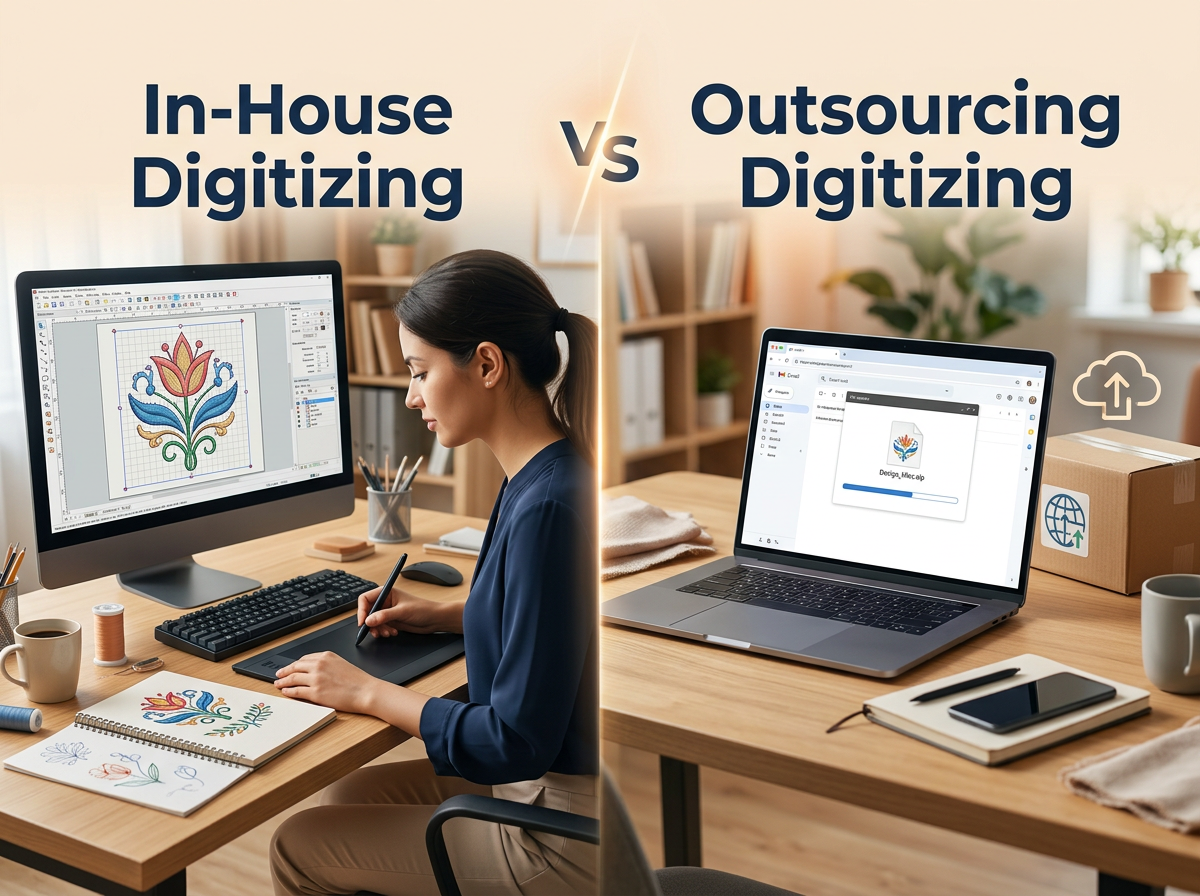
In-House vs. Outsourced Embroidery Digitizing: Which Is Right for You?
For most embroidery shops running fewer than 20–30 designs per month, outsourcing digitizing is more cost-effective than hiring an in-house digitizer, since software licenses and training costs outweigh what you'd spend on a per-design outsourcing fee. Shops running high, consistent volume — particularly those needing fast same-day turnarounds on repeat customer files — often reach a break-even point where an in-house digitizer becomes worthwhile. The right choice depends on your order volume, budget, and how much control you need over the process.
Quick Comparison
- Upfront cost: In-house requires software ($1,000–$3,000+) and a trained digitizer's time; outsourcing has no upfront cost.
- Per-design cost: In-house is cheaper per design once trained and at volume; outsourcing typically runs $15–$75+ per design depending on complexity.
- Turnaround: In-house can be same-hour; outsourcing is typically 12–24 hours (faster with rush service).
- Skill requirement: In-house needs a trained digitizer — this is a specialized skill that takes months to years to master well; outsourcing needs none.
- Scalability: Outsourcing scales instantly with order volume; in-house is limited by your digitizer's capacity.
- Quality consistency: In-house gives direct control; outsourcing depends on the provider's quality standards and revision policy.
When In-House Digitizing Makes Sense
In-house digitizing tends to pay off when a shop meets several of the following:
- Consistently digitizing 30+ new designs per month
- Frequently needing same-day or same-hour turnaround for walk-in or rush customers
- Working with highly specialized techniques (elaborate 3D puff, appliqué, or complex multi-fabric jobs) where tight, hands-on control matters
- Already employing someone with digitizing experience, or able to invest months in training a staff member
- Wanting full ownership of design files without depending on a third party's availability
The tradeoff: digitizing software has a real learning curve, and a rushed or self-taught digitizer can produce files with poor stitch density, thread breaks, or fabric puckering — mistakes that cost more in wasted thread and garments than outsourcing would have.
When Outsourcing Makes Sense
Outsourcing tends to be the better fit when a shop:
- Runs lower or inconsistent design volume (under ~30 designs/month)
- Doesn't want to invest in software licensing, updates, or training
- Needs access to digitizers experienced across many fabric types and machine brands
- Wants predictable, flat per-design pricing instead of a fixed software + labor cost
- Is a newer shop still validating demand before committing to fixed overhead
The tradeoff: you're dependent on a provider's turnaround time and revision policy, and quality can vary between providers — so vetting a digitizing company's samples and reviews matters more here than with any other decision in the process.
Cost Breakdown: A Realistic Example
Say a shop digitizes 15 designs a month. Outsourcing at an average of $35/design costs roughly $525/month with zero upfront investment. Going in-house means paying for software (often $1,500–$3,000 one-time or a monthly subscription), plus either training an existing employee or hiring a digitizer, whose time then has to be paid whether design volume is high or low that month. At 15 designs/month, outsourcing is almost always cheaper. That math flips as volume climbs into the 40–60+ designs/month range, where the fixed cost of in-house work gets spread across far more output.
A Hybrid Approach
Many shops land somewhere in between: keeping routine, repeat designs in-house (or reusing already-digitized files) while outsourcing new, complex, or rush one-off designs to a digitizing service. This limits fixed overhead while still providing a fast option when needed.
Frequently Asked Questions
Is it cheaper to digitize in-house or outsource?
For low or inconsistent volume (roughly under 30 designs a month), outsourcing is usually cheaper since there's no software or training cost. At higher, consistent volume, in-house digitizing typically becomes more cost-effective per design.
How long does it take to learn embroidery digitizing?
Basic proficiency with digitizing software can take a few weeks, but producing production-quality files — with correct density, underlay, and pull compensation for different fabrics — typically takes several months to a year of regular practice.
What software is used for in-house embroidery digitizing?
Common professional digitizing software includes Wilcom, Hatch, Embrilliance, and Pulse. Pricing and learning curves vary, so most shops evaluating an in-house switch trial a demo version before committing.
Can I switch between outsourcing and in-house later?
Yes — many shops start by outsourcing while building order volume, then move some or all digitizing in-house once volume justifies the investment, or vice versa if in-house turns out to be more overhead than expected.
Every design we digitize is compatible with all major embroidery machines, including DST, PES, EXP, JEF, VP3, HUS, XXX, and many more.
Get Your Design Professionally Digitized
Whether you're stitching one logo or producing thousands of embroidered garments, professional digitizing is the key to achieving clean, consistent, and production-ready embroidery.
Let our experienced digitizers turn your artwork into a flawless embroidery file that stitches beautifully the first time.
Not sure what your design will cost? Send it over and we'll give you an accurate stitch count and quote before you commit.